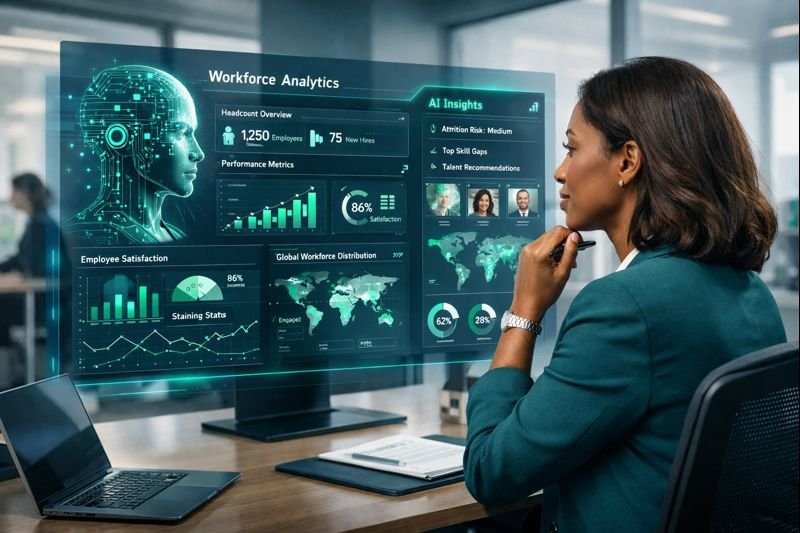
Marketing uses AI to personalize customer experiences. Finance uses it to detect fraud. Operations uses it to optimize supply chains. And HR? Too often, we're either ignoring AI entirely or approaching it with fear. Both responses are dangerous. AI isn't coming to HR—it's already here. The question is whether your organization will use it strategically or watch competitors pull ahead.
What AI Actually Means for HR (Not the Sci-Fi Version)
AI in HR isn't about robots conducting interviews or algorithms replacing human judgment.
AI in HR is about:
- Automating repetitive tasks humans shouldn't be doing anyway
- Analyzing patterns too complex for manual review
- Providing insights that help humans make better decisions
- Personalizing employee experiences at scale
- Freeing HR to focus on strategic work
Think of AI as handling the "heavy lifting" so HR can focus on judgment, relationships, and strategy.
Where AI Is Already Transforming HR
Talent Acquisition
Screen hundreds of resumes in minutes. Remove identifying information to reduce bias. Analyze job descriptions for biased language. Schedule interviews automatically. Predict which candidates are most likely to succeed.
Impact: Recruiters spend less time on admin, more time building relationships.
Learning & Development
Personalized learning paths based on skill gaps and preferences. Microlearning at the moment of need. Skills gap analysis across the organization. Adaptive learning that adjusts to individual progress.
Impact: Development becomes continuous and personalized, not one-size-fits-all.
Performance Management
Analyze feedback patterns to identify management issues early. Surface performance trends before they become problems. Identify flight risk based on engagement signals. Track goal progress with automated nudges.
Impact: Performance management becomes proactive and data-informed, not reactive and subjective.
Employee Engagement
Analyze engagement survey data to identify drivers. Monitor communication patterns for early warning signs. Predict attrition risk and trigger retention interventions. Provide managers with real-time team insights.
Impact: Engagement becomes measurable, predictive, and actionable—not just an annual survey.
HR Operations
Streamline benefits enrollment, leave management, payroll queries, policy questions, and onboarding workflows through chatbots and automation.
Impact: HR spends less time answering repetitive questions, more time solving complex problems.
The AI Adoption Framework for HR
Stage 1: Process Automation
Start with clear, rules-based processes: resume screening, interview scheduling, onboarding workflows, common employee queries.
Stage 2: Data-Driven Insights
Once you have clean data, use AI for analysis: attrition patterns, hiring needs, engagement drivers, skill gaps.
Stage 3: Predictive Intelligence
Move to predictive applications: flight risk modeling, performance prediction, succession planning, workforce scenarios.
Stage 4: Personalization at Scale
Customize experiences for each employee: personalized learning, customized career pathing, tailored communication.
Most organizations should start at Stage 1. Very few in Bangladesh are ready for Stage 4.
The Critical Success Factors
1. Data Quality
AI is only as good as your data. Before implementing AI: clean existing HR data, establish governance standards, understand what data you have and need.
2. Clear Use Cases
Don't implement AI because it's trendy. Start with: What's broken that AI could fix? What's slow that AI could accelerate? What's invisible that AI could illuminate?
3. Change Management
Address the fears directly: Will AI replace my job? Can we trust AI decisions? Will AI perpetuate bias? Build credibility with high-impact, low-complexity wins first.
4. Human-in-the-Loop Design
AI should provide recommendations, not make final decisions. Surface insights, not dictate actions. Handle routine tasks while humans handle exceptions. The best AI augments human judgment, never replaces it.
5. Ethics and Fairness
Essential safeguards: regular audits for bias, diverse design teams, transparency about AI use, human oversight of decisions, employee privacy protection.
The Bangladesh Context
Opportunities:
- Leapfrog outdated systems directly to AI-enabled processes
- Scale HR capability without proportional headcount growth
- Compete globally for talent using similar tools
- Build data-driven HR practices from the ground up
Challenges:
- Limited local AI expertise in HR applications
- Data privacy and security concerns
- Budget constraints
- Change resistance in traditional cultures
- Infrastructure readiness
Good news: AI tools are becoming more accessible and affordable. You don't need a massive budget or data scientists to start.
Getting Started: The Practical Path
Step 1: Assess Current State
What are your biggest HR pain points? Where does HR spend time on low-value tasks? How good is your current data?
Step 2: Identify Quick Wins
Which processes could be automated easily? What data could yield immediate insights? Where would AI have visible impact?
Step 3: Build Foundation
Clean critical data. Establish basic analytics. Create data governance. Develop AI literacy in HR team.
Step 4: Start Small, Learn Fast
Pilot one application. Measure impact rigorously. Learn what works in your context. Adjust based on feedback.
Step 5: Scale Strategically
Expand successful pilots. Add complementary applications. Build internal capability. Integrate AI into HR strategy.
The Future of HR Is Human + AI
The winning combination:
AI excels at: Processing large data volumes, identifying patterns, automating routine tasks, providing consistent treatment, operating 24/7, scaling without cost.
Humans excel at: Understanding context and nuance, navigating ambiguity, building relationships, making ethical judgments, showing empathy, handling exceptions.
When AI handles routine queries, data entry, and simple approvals, HR professionals can focus on strategic workforce planning, complex problem-solving, leadership development, culture building, and change management.
This is an upgrade, not a threat.
From AI Anxiety to AI Advantage
The organizations that will win aren't the ones with the most advanced AI. They're the ones that combine AI capability with human judgment to make better people decisions, faster.
Are you ready to be one of them?
Ready to explore how AI can transform your HR function? Let's have a conversation about where to start and what's realistic for your organization.