Let me tell you about two organizations I've worked with.
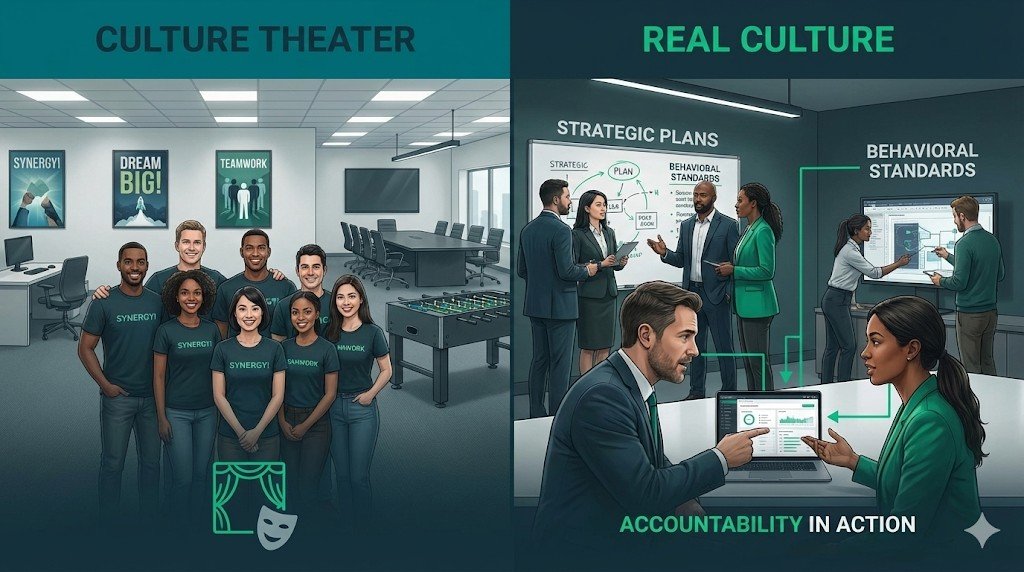
Company A had beautiful values displayed everywhere: "Integrity, Innovation, Collaboration, Excellence." They held quarterly town halls where leaders spoke passionately about culture. They had team events, recognition programs, and culture committees.
Their actual culture? Politics and blame. Information hoarding. Mediocre performers protected by relationships. Customer issues ignored unless they escalated. Innovation discussed but never resourced.
Turnover among high performers: 35% annually.
Company B had no values posters. No formal culture programs. No elaborate events.
But they had clear expectations: deliver results, help teammates succeed, own your mistakes, challenge ideas respectfully, solve problems rather than assign blame.
And critically—they had consequences when people violated these norms. A leader who publicly berated a team member? Coached once, then transitioned to an individual contributor role. A star performer who refused to collaborate? Moved to a position with less team dependency. Repeated pattern of missing commitments? Addressed directly with clear accountability.
Their culture? High-performing, collaborative, psychologically safe. People worked hard but felt supported. Problems surfaced early. Learning happened fast.
Turnover among high performers: Under 10%.
Company B's approach is right. Company A's is organizational theater.
Culture isn't what you say or celebrate. Culture is what you tolerate.
The Culture Delusion
Most organizations approach culture backward.
They start with aspirations: "We want to be innovative," "We value collaboration," "We empower our people."
Then they try to create that culture through values statements, CEO speeches, team-building activities, and recognition programs.
These aren't bad. But they're peripheral to what actually creates culture.
What actually creates culture:
- What behaviors get rewarded (promotions, raises, opportunities)
- What behaviors get punished (or not rewarded)
- What behaviors get tolerated (even when they violate stated values)
- Who gets hired and who transitions (and why)
- How leaders behave (especially under pressure)
- What gets discussed and what gets ignored
Culture is the pattern of these everyday behaviors and decisions. Everything else is decoration.
The Tolerance Test
Want to understand your actual culture? Ask these questions:
On Performance:
- Can someone deliver mediocre results for years without consequences?
- Do high performers get tired of carrying underperformers and leave?
- Is there meaningful difference in how top and average performers are treated?
On Integrity:
- Can leaders make commitments they don't keep without accountability?
- Do people say one thing in meetings and something different in private?
- Can someone take credit for others' work without consequence?
On Collaboration:
- Can someone succeed by hoarding information or undermining peers?
- Do silos persist despite complaints?
- Do politics matter more than merit for advancement?
On Innovation:
- Can someone kill new ideas without having to justify why?
- Are people punished for intelligent failures?
- Do we only do "innovation theater"—fancy words, no real experimentation?
The truth: If the answer to any of these is "yes," your actual culture contradicts your stated values. No amount of town halls or posters will change that.
Why We Tolerate Culture-Killing Behaviors
After two decades observing this pattern, here are the main reasons:
Short-Term Results Trump Long-Term Culture
We tolerate toxic behavior from high performers because we can't afford to lose their results. Sales leader hits numbers but treats team terribly? Tolerated. Star engineer delivers features but refuses to collaborate? Tolerated.
What happens: Good people leave. Norms erode. Others mimic the behavior. Long-term capability degrades despite short-term results.
Relationships Override Standards
We tolerate underperformance from people we like or have long relationships with. Long-tenured employee no longer performing? Tolerated. Manager who's well-connected despite poor results? Tolerated.
What happens: Meritocracy disappears. High performers become cynical. Political savvy becomes more valuable than capability.
Conflict Avoidance
We avoid confronting problems because it's uncomfortable. Team friction? Ignored. Broken process? Complained about but never fixed. Time-wasting meetings? Tolerated.
What happens: Problems compound. People lose respect for leadership. Good employees work around problems or leave.
Unclear Standards
Values are generic ("Respect," "Excellence") with no clear examples of what they look like in practice.
The result: Everyone has different standards. Without shared clarity, consistent culture is impossible.
What High-Performing Cultures Actually Do
1. They Make Values Behavioral and Specific
Instead of "Respect," define observable behaviors:
- Listen fully before responding
- Disagree with ideas, not people
- Assume positive intent until proven otherwise
- Give feedback directly, not through others
- Acknowledge contributions publicly
Instead of "Accountability," be specific:
- Own your commitments
- Communicate proactively when you'll miss deadlines
- Admit mistakes quickly and focus on solutions
- Take ownership of team outcomes
- Don't blame others or make excuses
Now you can observe, coach, and hold people accountable.
2. They Apply Consequences Consistently
First instance: Direct conversation—what happened, the impact, what needs to change. Clear expectations. Support to improve.
Repeated pattern: Formal feedback—"This is the second time. If it continues, we'll need to make changes including potential role adjustments or helping you find a better fit elsewhere." Timeline for improvement.
Continued pattern: Action—role reassignment, shift to individual contributor position, or mutual agreement to part ways, applied consistently regardless of seniority or performance.
Critical: These consequences must apply to everyone. The moment you make exceptions, your culture is defined by the exceptions, not the rules.
3. They Actively Shape Social Norms
Public reinforcement: When someone models desired behavior, acknowledge it: "I want to highlight what Nadia did. She surfaced a problem early, even though it was uncomfortable. That's the ownership we need."
Immediate correction: When norms are violated publicly, address it appropriately: "Let me pause. We've interrupted Rashed three times. Let's hear everyone's perspective fully."
Private accountability: When violations happen privately, address quickly: "In today's meeting, you dismissed Ayesha's idea without considering it. That shut down the conversation."
People constantly observe what gets reinforced and corrected. These signals shape culture more than any values statement.
4. They Hire and Transition Based on Culture Alignment
In hiring: Assess behavioral fit explicitly through situational questions, team interactions, and evidence of valued behaviors. Be transparent so candidates can self-select.
In transitions: Make cultural misalignment a legitimate consideration: "You're technically strong, but the way you work doesn't align with our collaborative approach. Let's discuss whether there's a role here that's a better fit, or if we should help you find an organization where you'll thrive."
The hard part: Making difficult decisions about people who deliver results but create cultural friction. Organizations that address this thoughtfully send the clearest message about what matters.
5. They Make Leaders Accountable for Culture
Leaders are measured on:
- Team engagement and retention
- 360-degree feedback on leadership behaviors
- Team culture quality
- Development of team members
The message: "We care about what results you deliver and how you deliver them and what culture you create."
Making Difficult Transitions Constructive
When someone isn't aligned with your culture, the conversation doesn't have to be adversarial. High-performing organizations handle these transitions with dignity:
The approach: "We've had several conversations about collaboration expectations. Despite good faith efforts on both sides, the fit isn't working. We want to support you in finding a role where you'll be more successful—whether that's a different position here or helping you transition to an organization better suited to your working style."
What this provides:
- Clarity about the situation
- Respect for the person's dignity
- Support for their next step
- Clear message to the organization about standards
The goal isn't punishment—it's ensuring everyone is in roles where they can thrive while maintaining cultural integrity.
What Success Looks Like
Behavioral shifts:
- People speak up about problems early
- Underperformers improve or find better-fit roles
- Collaboration becomes natural
- Innovation happens
- Politics and blame decrease
Business outcomes:
- Engagement and retention improve
- Faster decision-making
- Higher quality work
- Ability to attract top talent
- Better customer outcomes
Organizational resilience:
- Can navigate challenges without cultural erosion
- Can scale while maintaining culture
- Self-corrects when issues arise
Most importantly: Culture becomes simply "how we work."
The Bottom Line
Culture isn't about posters, perks, or programs. It's about what behaviors your organization rewards, addresses, and tolerates every day.
If you tolerate toxic high performers, that's your culture. If you tolerate mediocrity, that's your culture. If you tolerate politics over performance, that's your culture.
Everything else is decoration.
The good news: Culture is within your control. Not easily, not quickly, but definitely.
It requires:
- Honest diagnosis
- Behavioral clarity
- Courage to address violations consistently
- Systems that reinforce desired behaviors
- Sustained attention over time
Most organizations prefer culture theater to culture building.
Which creates opportunity for those willing to get serious.
Are you ready to stop celebrating culture and start building it?
Need help moving from culture theater to culture building? Let's discuss how to diagnose what you're actually tolerating—and create accountability systems that stick.